2025 How to Use Triethyl Citrate for Safe and Effective Applications
Triethyl Citrate (TEC) has emerged as a versatile compound in various industries, including food, pharmaceuticals, and cosmetics, due to its non-toxic and biodegradable properties. According to a report by the European Food Safety Authority (EFSA), Triethyl Citrate is recognized as a safe food additive, with specified usage levels that do not pose health risks to consumers. This secure profile has led to its growing application in food preservation and flavor enhancement, particularly in the formulation of food packaging materials.
Industry expert Dr. Emily Carter, a leading researcher in food additives at the Institute for Food Safety, states, "Triethyl Citrate not only ensures product safety but also improves the overall quality of food products." This reflects the compound's ability to function effectively as a plasticizer, stabilizer, and flavoring agent, which enhances the appeal of food while conforming to quality standards.
As we move towards 2025, understanding the safe and effective applications of Triethyl Citrate becomes crucial for manufacturers aiming to align their products with health consciousness and sustainability goals. Navigating the regulatory landscape and optimizing formulations will be key in harnessing the full potential of this valuable compound. Through careful application and adherence to industry guidelines, Triethyl Citrate can significantly contribute to safer and more effective product development across various sectors.

Understanding Triethyl Citrate: Composition and Properties
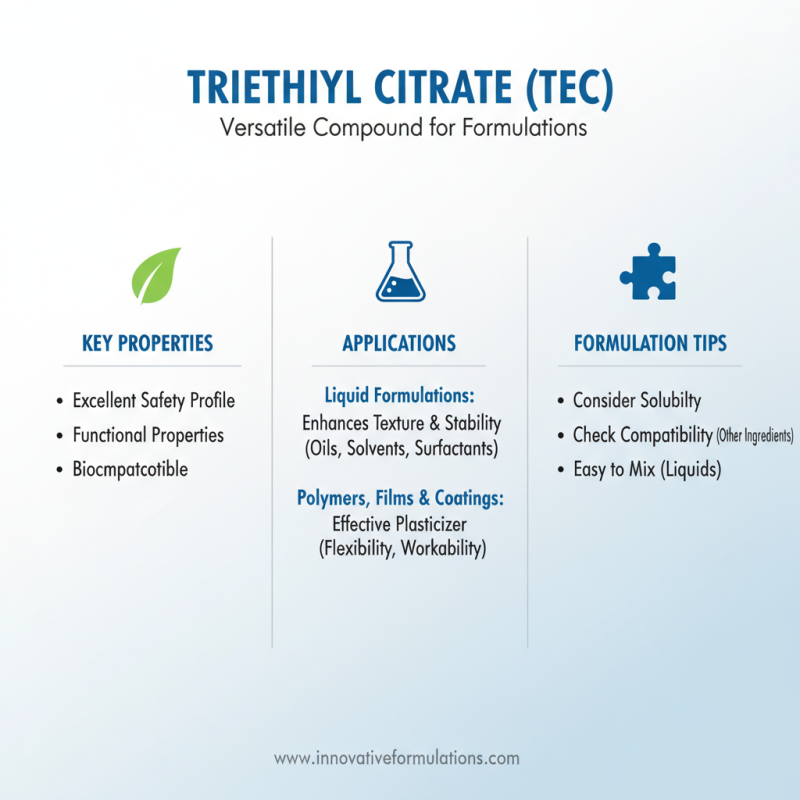
Triethyl citrate is a colorless, odorless, and non-toxic ester derived from citric acid. Its chemical composition comprises three ethyl groups attached to a citrate molecule, which grants it unique properties that make it valuable across various industries. Primarily used as a plasticizer and solvent, triethyl citrate offers excellent compatibility with a range of polymers, enhancing their flexibility and durability. Additionally, its low volatility and high thermal stability contribute to the performance of products in which it is incorporated.
The properties of triethyl citrate extend beyond its role as a plasticizer. It is recognized for its biocompatibility and mildness, making it suitable for use in cosmetic and pharmaceutical formulations. Its ability to function as an emulsifier enables it to stabilize mixtures of oil and water, while its performance as a filler and skin conditioning agent enhances the overall user experience in topical applications. Furthermore, triethyl citrate exhibits biodegradability, aligning with the growing demand for sustainable ingredients. These characteristics make it an attractive choice for manufacturers seeking safe and effective solutions in their product line-ups.
Safety Profile of Triethyl Citrate for Various Applications
Triethyl citrate is a versatile compound widely used in various applications, including food, pharmaceuticals, and cosmetics. Its safety profile is one of the key factors contributing to its popularity. Identified as a non-toxic, biodegradable substance, triethyl citrate poses minimal risks when used in appropriate concentrations. Studies have demonstrated that it has a low irritation potential, making it a suitable ingredient in products applied to the skin or mucous membranes. This characteristic is essential for formulations intended for sensitive or vulnerable populations, such as children or individuals with allergies.
Moreover, triethyl citrate acts as a plasticizer in polymers, enhancing flexibility without introducing harmful additives. Its ability to improve the texture and stability of products makes it favorable for applications in food packaging and medical devices. Regulatory bodies have evaluated its safety and approved its use within defined limits, further underscoring its acceptability in consumer products. By adhering to recommended guidelines, manufacturers can effectively harness the benefits of triethyl citrate while ensuring consumer safety across various applications.
Methods of Incorporating Triethyl Citrate in Formulations
Triethyl citrate (TEC) is a versatile compound that is widely utilized in various formulations due to its excellent safety profile and functional properties. When incorporating TEC into formulations, it is essential to consider its solubility and compatibility with other ingredients. For liquid formulations, TEC can be easily mixed with oils, solvents, and surfactants, enhancing texture and stability. It serves as an effective plasticizer, improving the flexibility and workability of polymers in products like films and coatings.
In solid formulations, triethyl citrate can be blended with powders to enhance flowability and reduce dusting. Additionally, when formulating cosmetic products, TEC acts as a skin conditioning agent while also serving to modify the viscosity of creams and lotions. Its biocompatibility makes it suitable for sensitive applications, such as baby care items and personal care products. Adopting the right methods of incorporation, such as using high-shear mixers or homogenizers, can ensure a uniform dispersion of TEC, thereby maximizing its beneficial properties.
Effective Dosages of Triethyl Citrate for Desired Outcomes
Triethyl citrate (TEC) is gaining attention for its versatility in various applications, particularly within the pharmaceutical and cosmetic industries. This organic compound is recognized for its role as a solvent and plasticizer, notably in formulations that require skin compatibility and enhanced absorption. According to a recent report by the European Commission's Scientific Committee on Consumer Safety, safe use concentrations of triethyl citrate in personal care products should generally range between 1% and 10%, ensuring effectiveness without compromising skin integrity.
In terms of dosage, studies suggest that using triethyl citrate at approximately 5% concentration can yield optimal results, especially in topical medications aimed at improving skin hydration and elasticity. The Literature Review in the Journal of Cosmetic Dermatology highlights how formulations with this dosage demonstrate significant improvement in skin barrier function, correlating with the observed increase in moisture retention. Additionally, when incorporated into aroma therapeutic applications, a dosage of 3% to 5% has been found to enhance fragrance longevity while remaining hypoallergenic. The careful calibration of these dosages ensures that users can enjoy the benefits of triethyl citrate without adverse effects, promoting both safety and efficacy.
2025 How to Use Triethyl Citrate for Safe and Effective Applications - Effective Dosages of Triethyl Citrate for Desired Outcomes
| Application |
Effective Dosage (g) |
Desired Outcome |
Safety Notes |
| Cosmetic Formulation |
1.0 - 5.0 |
Skin Conditioning |
Patch test recommended |
| Food Additive |
0.5 - 3.0 |
Flavor Enhancer |
Adhere to local regulations |
| Pharmaceutical Use |
0.1 - 2.0 |
Solubilizer |
Consult a healthcare professional |
| Industrial Applications |
5.0 - 20.0 |
Plasticizer |
Use with protective gear |
Regulatory Guidelines for the Use of Triethyl Citrate in Products
Triethyl citrate (TEC) is increasingly recognized for its versatility and safety in various applications, particularly in personal care and food industries. When integrating TEC into products, it is essential to adhere to specific regulatory guidelines to ensure consumer safety and compliance. These guidelines often cover aspects such as concentration limits, labeling requirements, and safety assessments, which are critical in mitigating any potential risks associated with its use.
Furthermore, regulatory bodies emphasize the importance of thorough toxicological evaluations before TEC is incorporated into any product. These assessments help to confirm that TEC does not pose significant health risks when used as directed. Manufacturers should also be aware of the necessity to regularly review updates in regulations and ensure that their products meet the latest safety standards. Effective communication with regulatory authorities can facilitate this process and support product approval, ensuring that TEC maintains its reputation as a safe and effective ingredient for various applications.